
The Event Audience Playbook: own the names, not just the night
A promoter's system for turning every night into names you own - capture points, consent that holds up, segments that maintain themselves, and the sending discipline that keeps a list worth having.
TL;DR
- The morning after your show, the ticket platform emails the people who came to it. Not about your next night, about whatever its recommendation engine thinks they will buy, which on a busy weekend is the promoter running against you.
- Marketplaces do usually pass you the buyer's details. What they never pass is exclusivity: they keep their own relationship with that fan. One of you booked the room. Two of you message the crowd.
- An owned audience means four things: direct contact details, provable consent per channel, purchase and attendance history, and the ability to export the lot and walk away.
- Capture at five touchpoints: checkout, a keyword announced in the room, QR posters, contests, the guest list. A busy night should add contacts, not just bar takings.
- Give each channel one job. Email carries the detail, SMS is the fire alarm, WhatsApp is the community room. Every text spends from a trust budget you cannot top up.
- For your own past buyers, PECR's soft opt-in. For everyone else, an affirmative tick per channel. For a bought list, nothing lawful.
- On modest assumptions a subscriber is worth about £3 a year to a promoter running ten £15-ticket events. The model inside computes yours.
The problem: you built the crowd, someone else keeps the names
The morning after your show, the ticket platform emails the people who came to it. Not about your next night, about whatever its recommendation engine thinks they will buy, which on a busy weekend is the promoter running against you. Your door count is someone else's targeting data.
The room is under pressure while that happens. Nightclub numbers are down 36.1% on March 2020, an average of about six net closures a month (NTIA and NIQ, September 2026). The more useful figure is the churn underneath: 48% of pre-Covid late-night venues still trade unchanged, 38% have exited, 14% are new. Venues turn over and so do the nights inside them. The list of people who came is the one asset that survives both, and it puts your next event in front of last month's crowd tonight for pennies.
Without one you rent your reach from three landlords.
Landlord one is the ticket marketplace, and the real complaint is worse than the usual one. You do normally get a file. What you never get is exclusivity: the platform keeps its own relationship with that fan, drawing inferences from "events attended" to "help target advertising or customize recommendations". The fee is only the visible half of that bargain. Skiddle publishes 10% of face value plus 27p, so a £15 ticket carries £1.77 and the fan pays £16.77, passed to them by default. It is not a bill you receive. It is a higher price on your show, paid by the person you most want back next month.
Landlord two is the algorithm. Median Instagram engagement is 0.30% of followers per post, down from 0.36% the year before (Rival IQ, 2026). Read the denominator: that is likes and comments as a share of followers, not the share of followers who saw the post. A dial you cannot see decides how many of the people who chose to follow you get your announcement.
Landlord three is the ad platform. Apple's 2021 tracking change permanently degraded ad-platform signal, so the ads you buy to work around landlord two cost more and report less.
Owned reach is the opposite of all three. UK marketers put email's return at around £41 per £1 spent (DMA, 2026), which is their own estimate rather than an independent measurement, and a text reaches a fan the moment you send it. Both work only when the names sit in your database with consent attached.
What you're probably doing wrong
Most promoters are not doing zero audience work. They are doing the comfortable half of it:
- Treating the marketplace export as the relationship. You hold the file. So does the platform, and it is mailing your buyers on its own schedule.
- Counting followers as an audience. A follow is a lottery ticket for the algorithm's attention, not a way to reach someone.
- Collecting nothing at the event. Four hundred people in a room you booked, and the only device capturing data all night is the card machine.
- One vague consent box, or none. No record of who ticked what means the addresses you worked hardest for are ones you cannot lawfully use.
- Importing a list someone lent you. A guest list question is not an opt-in, and another promoter's spreadsheet arrives with none of the consent and all of the spam complaints.
- Blasting the whole list identically. The house heads get the drum and bass lineup, and weekly texts torch the one channel that reliably gets read.
Why listen to us
We build SoundOps, which runs ticketing, CRM and email, SMS and WhatsApp campaigns for promoters every day. That seat shows us which capture tactics fill databases and which quietly collect nothing. Everything here works with a spreadsheet, a form builder and any decent email tool.
The system
1. What does "owning your audience" actually mean?
Four tests. Miss one and you are still renting.
- Contact. A direct address: an email, a mobile number, a WhatsApp opt-in. Not a follower ID on someone else's platform.
- Consent. You can show when, where and how each person agreed, per channel.
- History. You know what each person bought, attended and clicked. History turns a list into a targeting tool instead of a megaphone.
- Portability. You could export the whole thing as a CSV this afternoon. If a platform holds your contacts hostage, they were never yours.
| Ticket marketplace | Social following | Owned list | |
|---|---|---|---|
| Who holds the buyer's details | Both of you | The platform | You |
| Who else messages them | Its recommendations, often competing nights | Every account they follow | Nobody, unless you say so |
| Can you message them tomorrow? | Only on the wording its checkout used | Only if the algorithm allows | Yes |
| Does it bring you strangers | Yes | Sometimes | No |
That last row is the one real argument against everything else here: a marketplace reaches people who have never heard of you, and your list cannot. The answer is not to delist. It is to sell to your own crowd first.
2. How do you collect fan data at events and online?
Put a capture point everywhere a fan touches your brand. Five cover most promoters.
Checkout. The highest-intent moment you will ever get. One unticked box for email, a separate unticked box for SMS, and copy that keeps its promise: "Email me about future [brand] events. Unsubscribe any time." Done properly this sets up the soft opt-in for your buyers. Wire up the abandoned basket and the sold-out waitlist the same way.
Shortcut: if your ticketing runs on SoundOps, every buyer arrives in your CRM. By default a paying buyer joins your email list under the soft opt-in unless they tick "Don't email me news and offers" by the buy button before paying, and the page after paying still lets them untick it; switch that off in Settings and that page asks instead, unticked. Each answer is recorded with its basis, the surface and the country, rather than just a tick.
A keyword in the room. On the screens and out of the MC's mouth at peak: "Text DISCO to this number for first access to the next one." The fan starts the conversation, so the consent is easy to evidence. One catch nobody mentions: most UK business texts go out from an alphanumeric sender ID, a word rather than a number, which is one-way. This needs a rented inbound number.
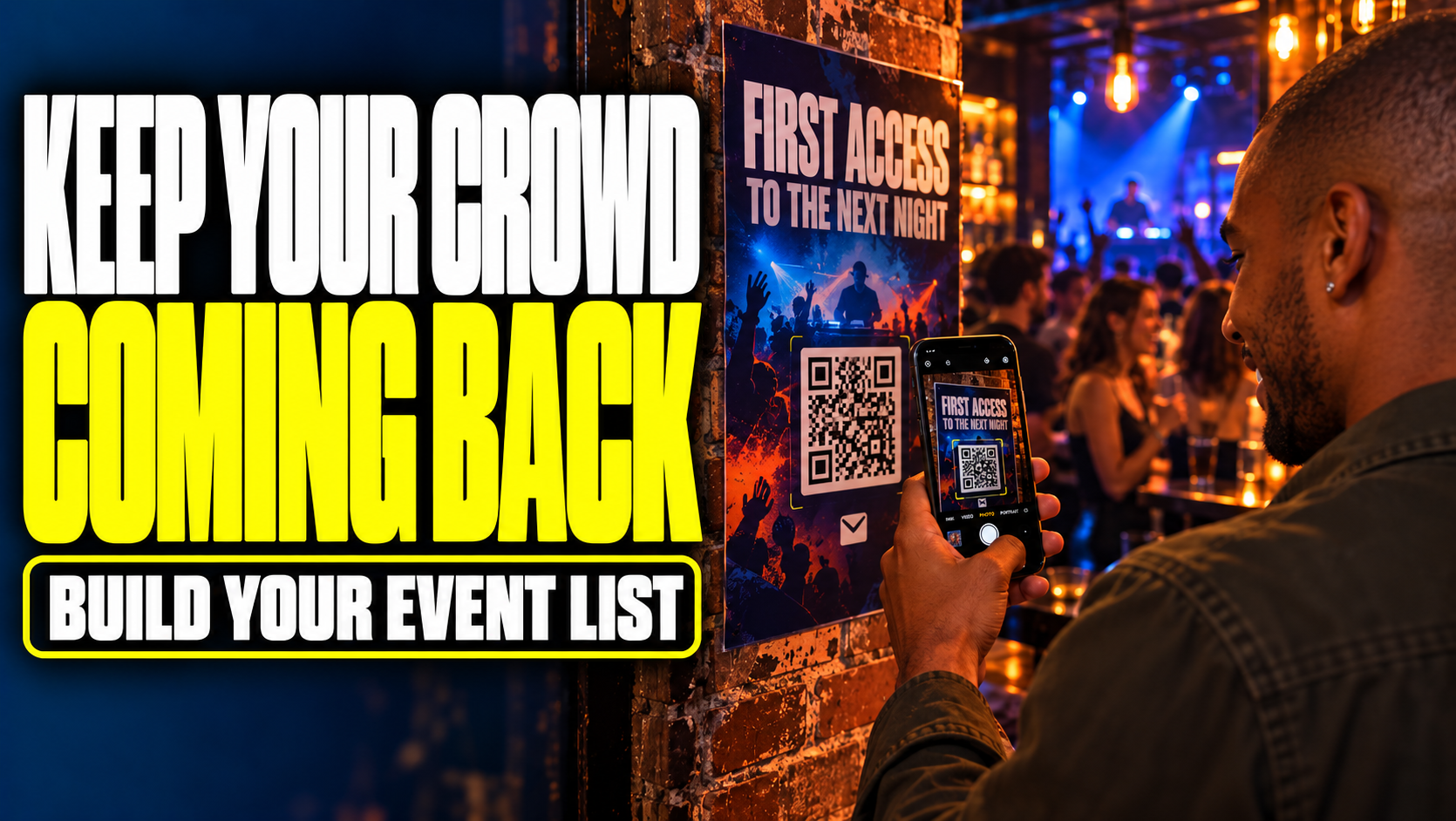
QR posters. Everywhere a queue forms: the bar, the cloakroom, the smoking area, the backs of the toilet doors. Toilet doors are prime real estate, a captive audience alone with a phone. One thing asked, one incentive offered: "first release tickets before the public." Use a different code per placement so you learn which wall works. If that page carries a Meta or TikTok pixel, ask for cookie consent before it fires, because retargeting someone who scanned a toilet door is the most visible breach a fan can find in their own browser.
Shortcut: in SoundOps each poster code is a smart link with its own analytics, so "contacts from the toilet-door poster" is a filter.
Contests. "Win two tickets and a booth" earns entries a plain signup form never will. One per cycle, with a clearly worded optional opt-in, because entering is not blanket consent. If the only way in is buying a ticket you need a free entry route too, or it can be an unlawful lottery.
Guest list and RSVP forms. If free entry runs through a form, that form carries an unticked opt-in. You do have to ask: the soft opt-in rests on a sale, and a free signup is not one.
Three rules across all five. Trade value first, because "get tickets before the public" converts and "join our mailing list" does not. Record the source. And say who you are and what you will send as you ask, because consent to an unnamed sender is not consent.
3. What does UK consent law actually require? (PECR soft opt-in, in plain English)
Four rules cover almost every promoter. A working summary, not legal advice, and it is UK law.
- Your own past buyers: the soft opt-in. You may market your own similar events to someone whose details you took during a sale, provided you offered a clear opt-out then and in every message since. That is what makes emailing past ticket buyers lawful without a ticked box, and it covers texts as well as email.
- A marketplace sale is not your sale. The details were not obtained in the course of it, so your basis is whatever that checkout collected on your behalf. Read what its box actually said, and write it down.
- Everyone else needs an affirmative tick, per channel. Contest entrants, guest list signups, QR scanners. A fan who ticked "email me" has not agreed to texts: the ICO is explicit that consent must be specific to the type of message you want to send.
- Never buy or borrow a list. It carries no consent you can rely on and brings spam complaints that wreck your reach to the people who did opt in. Propose a co-promoted event instead, and capture consenting fans for both brands.
Keep the evidence for all four: what the person was shown, when, and through which capture point. If you cannot prove it, treat the consent as if it does not exist. The stakes moved on 5 February 2026, when PECR breaches shifted onto the Data Protection Act penalty scale and the old £500,000 ceiling went. The FAQ answers the specific cases, including US senders, where the rules are inverted rather than similar.
Shortcut: this is the part a platform does better than a spreadsheet. Every SoundOps capture form stores the wording shown, the surface, the timestamp, the basis and the per-channel status, and every later change is appended to a consent history nobody can edit.
4. Which channel does which job?
Give each channel exactly one job and your messages start feeling like service instead of noise.
Email carries the detail. Lineups, timings, tiers, the story of the night. Three sends per cycle: the announcement, a mid-cycle reason to care, and an honest final push. Eventbrite found 57% of tickets are bought a week or less before the show (US music events, 2024). The last-week email is not a nag. For most of your buyers it is the one they were waiting for.
SMS is the fire alarm. The on-sale going live, the final release nearly gone, day-of door info, a lineup change. It works because a text lands on a lock screen rather than in a promotions tab, which is exactly why you never spend it on "just checking in". A cancellation or door change is not marketing at all, so it goes to everyone holding a ticket whatever they ticked.
The SMS trust budget. Treat each contact's tolerance as roughly one to two texts per cycle, and every message as spend. An on-sale alert they asked for is money well spent. A third "last chance!!" in a week is an overdraft, and the fee is an opt-out you never get back.
WhatsApp is the community room. Strictly opt-in, best for the inner circle. Say which WhatsApp you mean, because there are three. A consumer group shows every member's number to every other member, a disclosure your fans never agreed to. A Channel is broadcast-only rented reach, the same bargain as the feed. The Business Platform behaves like a channel you own, but Meta bills it per marketing template message, so "pennies" stops being true.
One rule about the words, not the channel. Any price you put in a message has to be the total including mandatory fees, so a text saying "£15" for a ticket costing £17.50 at checkout is a problem, not a shortcut. And "final release, closing tonight" becomes a banned practice the second time you send it. Scarcity only works while your word is good.
5. What segments actually get used?
Three segments cover most of what a promoter needs, and three is the number you will actually maintain.
- Past buyers vs never-bought. Buyers get loyalty treatment: presale first, a thank-you after the show. Never-boughts get persuasion: social proof, the aftermovie, a first-timer offer. Sending both the same message wastes the strongest card you hold, "you were there".
- By night or genre. The disco crowd should not headline the mailout for the 140bpm all-nighter. Wrong-genre email is the politest form of spam, and it still costs unsubscribes.
- Engaged vs cold. Define engaged by what a fan did: clicked, bought, replied or got scanned at the door in the past 90 days. Opens are no longer evidence, because Apple's Mail Privacy Protection pre-loads images for much of any consumer list, so those contacts log an open nobody made.
Ask who a campaign is for and who it would annoy, then send to the first group. Only genuinely big news earns the whole list.
6. What is a subscriber actually worth? (a model you can steal)
Five minutes, three assumptions, all of them yours to replace. Treat the output as an illustration, never a benchmark.
| Assumption | Value used here |
|---|---|
| Events per year | 10 |
| Average ticket price | £15 |
| Share of the emailed list that buys, per event | 2% |
A 1,000-contact list at a 2% buy rate is 20 tickets per event. At £15 across 10 events that is £3,000 a year attributable to the list, about £3 per contact per year. At 1% it is £1.50. At 4% with a £20 ticket it is £8.
Even with rough inputs that settles two arguments. Capture effort pays for itself fast: if a contact is worth £2 to £3 a year, a toilet-door poster that adds 30 signups repaid its print cost many times over, and the hour spent wiring consent into checkout is the best-paid hour of your month. The list makes your ads cheaper: uploaded as a custom audience it excludes people who already bought, so acquisition spend stops paying to reach the converted.
Every buyer whose details you never took on your own terms is that same value forgone, every year.
7. The 30-day plan: zero to your first thousand contacts
Running one event a month, the full thousand takes longer than 30 days. The order is what matters.
Week 1, plumbing. One database. The consent wording written once and live on checkout, guest list and RSVP. A keyword, a signup page, QR posters. Your sending domain authenticated. Check whether you need to pay the ICO's data protection fee (its online self-assessment takes a few minutes) and pay it if you do: it is the cheapest legal step here and the first thing checked when a complaint lands.
Week 2, the lawful backfill. Import only what you can evidence, and read the wording your ticketing checkout used before you touch a row of it. Everything else gets one re-permission message or the bin. A small clean list beats a big haunted one.
Week 3, capture in the wild. Next event with the full kit live, plus one contest the DJs and the venue will share. Their reach, your capture.
Week 4, convert the attention you already get. Signup link directly under the aftermovie. Recap email with a date tease. Then check contacts per source and double down on the top two. Any source that produced nothing needs a better trade.
8. List hygiene: how not to burn what you built
A list decays unless maintained. Honour opt-outs instantly and never re-import anyone who left. Offer opt-down before opt-out, because most unsubscribes really mean "too much" and a preference page offering "only my genres" keeps a contact you would otherwise lose. Remove hard bounces at once, keep complaints under 0.10%, and run a sunset policy: six to twelve months with no click, purchase or reply earns one honest win-back, then removal. Never sunset on opens, and nothing promotional lands at 3am however nocturnal your crowd is.
Where SoundOps fits
You can run all of this with duct tape: a ticketing platform, a spreadsheet, an email tool, an SMS service, a form builder, and the discipline to keep six consent records in sync by hand. SoundOps is the same system with one record instead of six:
- Ticketing that feeds the list. Checkout runs on your own Stripe account, so you are paid directly and the buyer record is yours from the moment of sale. No per-ticket SaaS fee: your plan's platform fee of 1% to 2.5% plus Stripe processing, which on a £15 ticket is 15p to 38p, taken out of your money rather than added to your fan's price.
- Capture, wired in. QR-coded smart links for the posters, an RSVP form carrying the unticked opt-in, contest gates, WhatsApp and Instagram keyword capture, all writing to one contact record with the source stamped.
- One record, three channels. Consents, opt-outs and history stay coherent across email, SMS and WhatsApp. The trust budget is a per-channel frequency cap, the quiet hours you set are enforced at send, and email goes from your own verified domain.
- Segments that maintain themselves, off fields the product already fills: orders, the attendance tag the door scan writes, last activity. That tag is the one piece of history no marketplace export hands you.
- Hygiene, handled. Bounces flagged, complaints suppressed, a preference centre, a win-back preset, and a CSV export whenever you want one.
And where it doesn't fit. We do not list your event anywhere fans browse, so a marketplace still does something we do not: bring strangers. A guest list entry is a name the door recognises, not a contact record. WhatsApp needs your own Meta business account and its 24-hour reply window. SMS goes out on a sender ID rather than a number fans can reply to, so the opt-out is a link. And the consent wording here is a template, not legal review.
Pricing starts at £19 a month, with a 14-day free trial on Starter.
The condensed checklist
Foundations
- One database where every contact lives
- Consent wording written: unticked email box, separate unticked SMS box, who you are, what you send
- Consent records kept: date, source, wording shown
- Sending domain authenticated (SPF, DKIM, DMARC), one-click unsubscribe on
- Registered with the ICO, data protection fee paid
Capture
- Opt-in boxes at checkout, guest list and RSVP forms
- Keyword live on an inbound number, announced at every event
- QR posters up, one code per placement, source recorded on every contact
- Landing pages ask cookie consent before any pixel fires
Consent
- Soft opt-in only for buyers whose details you took yourself
- The wording your ticketing checkout used, read and written down
- No bought lists, no borrowed lists, ever
- Unevidenced old data re-permissioned once or deleted
Sending
- SMS held to one to two per cycle, for on-sale, last call and door info
- Every price in a message is the total including mandatory fees
- Three segments live, engagement measured on clicks not opens
- Hard bounces removed, complaints under 0.10%, sunset policy running
Frequently asked questions
Is it legal to email past ticket buyers without a ticked box?
In the UK, usually yes, under PECR's soft opt-in, if three things hold: you collected the details yourself during the sale, you gave a clear chance to opt out then, and every message since has offered one. If the sale went through a marketplace, your basis is whatever its checkout collected for you. A working summary, not legal advice.
Can I text ticket buyers about my next event?
In the UK there are two routes. If you took the number during your own sale, offered an opt-out then and offer one in every message, the soft opt-in covers texts as well as emails: PECR regulates "electronic mail" and the ICO includes texts in it. Otherwise you need consent that names texts, because the ICO says consent must be specific to the type of message. In the US the bar is higher: the TCPA requires prior express written consent.
Do SMS and WhatsApp really need separate opt-ins from email?
Yes, and keep each channel's status on the one contact record rather than in three lists, so you always know who you can reach where and withdrawing one does not quietly take the others with it. WhatsApp adds conditions of its own: the opt-in can be collected anywhere, but the wording has to name your business, and outside a 24-hour window after the fan's last message you can only send an approved template, which Meta bills you for.
Another promoter offered me their list. Can I use it?
No. Their consent does not transfer to you, so you would be messaging people who never agreed to hear from you: unlawful, and reputationally expensive. Since 5 February 2026 UK marketing-rules breaches sit on the Data Protection Act's penalty scale, not the old £500,000 ceiling. Propose a co-promoted event instead.
What if my tickets sell through a marketplace like Eventbrite or Skiddle?
Most pass buyer details to the organiser, so the question is not whether you get a file but what its box said and who else is mailing those fans. Eventbrite's privacy policy makes you the controller of the marketing subscription its checkout takes, while Eventbrite keeps mailing that buyer from inferences about the events they attended; Skiddle shares contact data so the promoter can contact buyers about that event, with further marketing needing its own opt-in. Price the arrangement while you are at it: Skiddle publishes 10% plus 27p, £1.77 on a £15 ticket, added to the fan's price by default rather than billed to you, and Eventbrite's UK rate is 6.95% plus 59p, about £1.63 on the same ticket, paid by the buyer by default in the same way. Wherever you sell, check three things: do you receive the details, can you word your own opt-in, can you export everything. Where any answer is no, build the capture points you control and move towards a checkout you own.
How often should I email and text my list?
Email your whole list two to four times per event cycle, each with something real to say, and send anything extra only to people who have not bought yet. SMS one to two, for on-sale, last call and door information. Running several nights a month, add the channels up per fan: someone getting three announcements experiences one sender, not three campaigns.
How big does my list need to be before it matters?
Smaller than you think. On the worked model in this playbook, 500 engaged local contacts at a 2% buy rate is 10 tickets per event before you spend a penny on ads, and those are the people most likely to bring friends. A small consented list beats a large cold one on every measure that pays.
What is a subscriber actually worth in money?
It depends on your events, prices and send quality, so compute it: events per year, times ticket price, times the share of your list that buys per event. The worked example here lands at roughly £3 per contact per year on deliberately modest assumptions. Replace them with your real numbers after a few sends.
What should I do with contacts who never click or buy?
After 6 to 12 months with no click, purchase or reply, send one honest win-back asking whether they still want to hear from you. No response means removal, or a deep-freeze segment you rarely message. Judge on clicks: Apple's Mail Privacy Protection makes opens unreliable for much of any consumer list.
Does GDPR stop me collecting data at events?
No. It requires that you collect fairly: say what you will send, get the right kind of consent per channel, record it, and make leaving easy. Every tactic in this playbook is built to meet that bar. The promoters who get into trouble are the ones improvising with bought lists and scraped DMs, not the ones asking clearly at the bar.
Know someone who needs this?
Send them the playbook. It is free to read, no signup needed.