
The Event Ticketing Playbook: 81 checks before your next on-sale
Fee surprise at checkout, tiers that create no urgency, a refund policy invented in DMs, one shared login at the door: on-sales lose money invisibly. 81 checks across seven areas, each with a one-line why, to run before you announce.
TL;DR
- On-sales lose money quietly: fee surprise at checkout, tiers with no urgency, a refund policy invented in DMs, buyer data that never reaches your list.
- Show the full price, fees included, wherever a price first appears. It fixes the most common cause of checkout abandonment, and it is law: UK since 6 April 2025, US since 12 May 2025.
- Run 3 to 5 named tiers with believable quantities, hide later ones until the earlier sell out, and never reopen anything called "Final". In the UK, a broken deadline is now a banned practice.
- Write your refund and cancellation policy before on-sale, offer a paid flexible-ticket upgrade (never call it insurance), and answer touts with face-value resale and a waitlist.
- Give door staff their own access, keep the guest list out of saleable stock, and print the list before doors: the basement eats the signal.
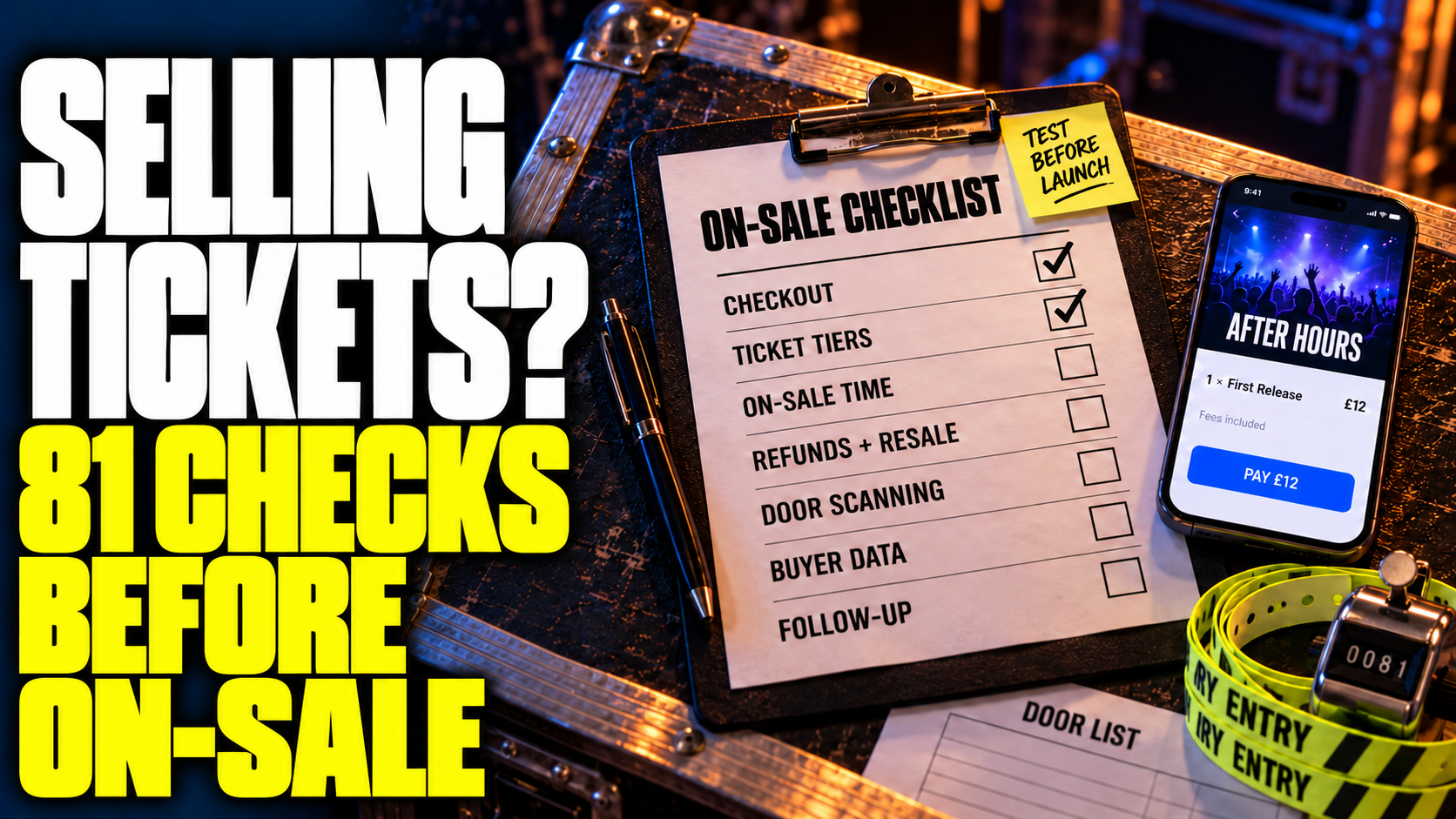
- 81 checks, seven areas, a one-line why on each. Print it, tick it, run it before every show.
The problem: most on-sales fail quietly
Britain has 28.7% fewer late-night venues than in March 2020, an average of about twelve net closures a month (NTIA and NIQ, September 2026). Whatever slack used to absorb a sloppy on-sale went with it.
The rest is your own doing, and it hides. The fan who abandons checkout when the fees appear does not email you. The queue from one shared scanner login shows up in no report. You sell fewer tickets, show after show, and blame the algorithm.
Fans also buy late: Eventbrite found 57% of US music tickets sold a week or less before the show in 2024, the average fan buying 18.5 days out. That week is calm or desperate depending on what you did before it. This checklist is the before.
What you're probably doing wrong
How many of these apply?
- Your fees first appear at the payment step, after the fan decided £12 was fair and is now asked for £14.36.
- One tier, General Admission, quantity 600. No reason to buy today rather than on the day.
- Your "Final release" reopened. Your regulars noticed, and will never buy early again.
- The door runs on your personal login, and the guest list lives in a group chat nobody subtracted from capacity.
- You cannot say which channel sold your last show. Your ticket platform knows your buyers. You do not.
None feel like emergencies. Together they are the difference between a show that washes its face and one that pays you.
Why listen to us
We build SoundOps: it sells the tickets, runs the door and puts the buyers in a CRM. From under those checkouts, shows rarely fail on the music. They fail on friction, fake scarcity, and data that never comes home. Nothing here requires our software.
How to use this checklist
Run it before every on-sale, not just the big ones. Every check is binary and carries a one-line why, because a checklist you do not believe is a checklist you skip. Operational checks work anywhere; legal lines are UK first, US where it differs, both dated.
Is your checkout costing you sales?
Yes, almost certainly, and the fix is showing the full price early. All-in pricing means the price a fan sees on the event page is the price their card is charged, fees included. A Department for Business and Trade review found drip pricing in 93% of the event-ticket businesses reviewed. In the UK it has been illegal since 6 April 2025 under the Digital Markets, Competition and Consumers Act 2024, and in June 2026 the CMA fined StubHub UK £889,200 and ordered more than £590,000 in refunds.
The United States version. The FTC's Rule on Unfair or Deceptive Fees took effect on 12 May 2025 and covers live-event tickets specifically, binding promoters as well as resale sites. In April 2026 StubHub agreed to refund $10 million over sales made inside the rule's first 48 hours. Same company, two regulators, one year.
- 1. Buy a ticket on your own phone, on mobile data, before you announce. Why: a desktop hides mobile friction.
- 2. Count the taps from event page to paid. Cut anything above roughly five. Why: every extra screen leaks buyers.
- 3. Guest checkout is on: no account needed to give you money. Why: an account wall kills impulse.
- 4. Apple Pay and Google Pay both work. Why: one thumb press, against a card number typed in a smoking area.
- 5. The full price, fees included, is the price on the event page. Any "from" price is one a fan can really buy. Why: extra costs top Baymard Institute's list of checkout abandonment reasons, and the CMA's "from £12" zoo fails because only a child could pay it.
- 6. Every price you quote, on flyers, posts and ads, includes the mandatory fees. Why: the CMA's first penalty under the Act, April 2026, was £4.2m against the AA and BSM over a £3 booking fee shown one page too late. The offence is the sequence, not the size.
- 7. The event page loads fast on 4G. Why: five seconds on a night bus gets no second chance.
- 8. No app install or login wall between a shared link and the buy button. Why: every barrier halves the chain.
- 9. Every bio and post links to the event page, not your homepage. Why: making a fan navigate is making a fan reconsider.
- 10. A declined card has a retry path, and you have tested it. Why: a second attempt saves the sale. A dead end loses it.
- 11. The confirmation email is branded, from your own domain, with the QR ticket, the doors time, the venue address and a calendar link. Why: the most-opened email you will ever send.
- 12. A test confirmation reached Gmail and Outlook, and your domain passes SPF, DKIM and DMARC. Why: Gmail and Yahoo want SPF or DKIM from every sender, and an unauthenticated domain can be refused outright or sent to spam, so either way the confirmation never lands.
- 13. The ticket itself opens on a phone with no login. Why: the fan at the door at 11pm has one bar of signal and zero patience.
Shortcut: SoundOps adds no booking fee to the fan's price, so the number on the event page is the number their card is charged.
How many ticket tiers should you run, and at what prices?
Three to five, named as phases, with believable quantities, steps big enough to feel, and a door price above the final advance. It only works while it is true. After the 2025 Oasis sale the CMA found no algorithmic dynamic pricing at all, just cheap tickets released first and the rest much higher, with nobody in the queue told that two prices existed. Ticketmaster now has to flag a tiered structure 24 hours ahead: check 32 with a lawyer attached.
- 14. Run 3 to 5 tiers, no more. Why: one price creates no urgency, seven creates a spreadsheet nobody reads.
- 15. Every tier carries a phase name: Early bird, First release, Second release, Final release. Why: the names say prices rise before anyone reads a number.
- 16. Later tiers stay off the ticket page until earlier ones sell out, and the announce says what they cost. Why: a tier reveal keeps the live price front and centre and lets "Early bird sold out" do your marketing, while naming the later prices up front follows the line the CMA took in its 2025 undertakings with Ticketmaster: fans told in advance when tiered pricing is in use.
- 17. Quantities are believable for your capacity. Why: a 10-ticket early bird on a 600-cap room reads as a stunt; a 300-ticket one creates no urgency.
- 18. The early bird is capped by quantity, with a published date as the backstop, and it genuinely ends. Why: it only trains people to buy early if it disappears.
- 19. You will never reopen or rename a tier called "Final". Why: scarcity is a currency and you devalue it the first time you print more. Schedule 20 of the DMCC Act bans false time-limited claims too.
- 20. Price steps are big enough to notice, £2 to £5 on a club ticket, not 50p. Why: a rise nobody feels is no deadline at all.
- 21. Group bundles if your crowd arrives in groups: pairs, 3-for-2, 4-for-3, with the saving shown. Why: it gives the group's organiser a reason to close it tonight.
- 22. The door price sits above the final advance and goes on the artwork. Why: it anchors every advance tier as a bargain.
- 23. Your mailing list gets an early window or a loyalty price before public on-sale. Why: your list is the cheapest ticket you will ever sell.
- 24. Each tier says in one line what it includes. Extras, an afterparty or a coach, sit at checkout unticked. Why: an unexplained price difference reads as a fee, and a pre-ticked box is not express consent under the Consumer Contracts Regulations 2013.
- 25. Break-even is calculated at a realistic sell-through, with PRS and any VAT inside it, and you know when the payout lands. Why: budgets built on a sell-out lose deposits, and money arriving after the night cannot pay one before it.
- 26. Concessions and companion tickets are decided now, booked from the event page, not your DMs. Why: "message us for access" asks a disabled fan to arrange their own reasonable adjustment.
- 27. A holdback for guests, artists and problems, around 5% of capacity, comes off sellable stock today. Why: last-minute comps are invisible lost revenue.
When should tickets go on sale?
At a moment you can actually staff, timezone spelled out, warm list waiting, every price rise dated and announced. Fans buy at any hour. You do not.
- 28. The on-sale moment is chosen for a reason you can say out loud. Why: appetite is not the constraint. Ticket Tailor puts 7.1% of all purchases in the 7pm to 8pm hour against 0.2% overnight. Staff it, then let the calendar beat the hour: just after payday.
- 29. The timezone is spelled out everywhere: "Friday 10am BST", never "10am". Why: one ambiguous timestamp costs sales and earns DMs.
- 30. For a one-off show, the announce and the on-sale are days apart, not hours. Why: that gap is where you build the list. A regular club night whose crowd already knows it can announce and go on sale together.
- 31. Interest capture runs in between: a first-access signup link. Why: a warm list turns hour one into a spike.
- 32. Every price-rise date is locked and announced in public: "price rises Friday". Why: a public deadline converts twice, before and as it lands.
- 33. Every price rise happens on the minute you said. Why: the deadline is the mechanism. Break one and fans ignore the next.
- 34. An on-sale reminder is scheduled for the minute tickets go live, text included. Why: event email opens at a median around 46% (inflated by Apple Mail Privacy Protection) and clicks at roughly 1.3% on MailerLite's 2026 benchmarks. Text runs at 40.64% in the events category on Subtext's 2026 benchmarks.
- 35. The buy link is tested an hour before on-sale, and at on-sale. Why: a dead link in minute one burns your best buyers.
- 36. Artwork and posts carry the date, time, timezone, starting price and link. Why: every screenshot of your flyer should sell a ticket.
- 37. Someone owns the first hour: watching sales, answering "link broken", fixing fast. Why: a problem found at minute five is still fixable.
What should your refund, resale and waitlist policy say?
A specific refund window published before on-sale, self-serve refunds, a paid flexible upgrade, face-value resale, and a waitlist before you sell out. Write it now, or improvise it at 11pm.
- 38. The refund and resale policy is on the page before on-sale, including what happens if the show is cancelled, postponed or loses its headliner. Why: the refund storm comes from you changing the show, and nobody writes that one down.
- 39. The refund window is specific: "full refund until 14 days before doors". Why: a fan who knew the rules rarely fights them after.
- 40. Refunds inside the window are self-serve. Why: every manual refund is fifteen minutes and a public argument.
- 41. A paid flexible-ticket upgrade sits at checkout, refundable for any reason until a cutoff. Why: fence-sitters convert once the risk is gone, and the premium is revenue.
- 42. You call it a flexible ticket, never insurance. Why: effecting insurance is a regulated activity. Booking Protect sells its cover as insurance through an FCA-authorised insurer. Protect Group pointedly does not. Same in the US, licensed state by state.
- 43. The premium is roughly 10 to 15 percent of the ticket price, with a stated cutoff: 24 hours before doors. Why: a clear upgrade sells itself. A vague one is a fee in a costume.
- 44. Face-value resale is your answer to touts: the seller gets exactly what they paid, and the buyer gets a fresh one. Why: it keeps the room full and the tout's margin at zero. UK law is heading the same way: the November 2025 commitment caps resale at the original price plus the unavoidable fees the first buyer paid. In the United States there is no federal equivalent.
- 45. Each order has a ticket limit, and the page says what it is. Why: touts need volume. A cap of four or six starves them.
- 46. A refunded or resold ticket is actually cancelled: the old QR stops scanning once the ticket is listed or refunded. Why: otherwise one seat walks through your door twice, at 11pm.
- 47. The waitlist is live before you sell out. Why: a waitlist turns peak demand into a contactable queue.
- 48. Returned or relisted tickets notify the waitlist automatically, oldest first. Why: first-come-first-served is the only order fans accept without argument.
- 49. "Sold out" is announced loudly the moment it is true, naming the only legitimate way a ticket comes back. Why: it is the best advert your next show gets, and where fake accounts turn up with your artwork. Say you never DM tickets.
Shortcut: self-serve refund windows, Flexible tickets, face-value resale with automatic refund of the seller, and the sold-out waitlist are built into a SoundOps event, not policies you enforce by hand.
Will your door actually work at 11pm?
The door is where ticketing stops being software and starts being people in the cold.
- 50. A written scan plan: who scans, on which phone, from when. Why: the queue is your first impression.
- 51. Enough scanners that your busiest 30 minutes does not queue. Why: arrivals come in a wave, and one phone cannot drink a wave.
- 52. Door staff get a per-event link and PIN, never your login. Why: a shared login leaves with whoever worked that night.
- 53. That access dies when the night does. Why: yesterday's team should not open today's data.
- 54. Staff know the three scan states, green in, amber already scanned, red invalid, and a script that ends by handing over. Why: amber is where fights start. Refusing entry or removing someone is licensable under the Private Security Industry Act, so check who holds a licence.
- 55. Guests check in on the guest list, never the ticket list. Why: mixed lists wreck your headcount.
- 56. The guest list has one owner and a cutoff. Why: "I'm on the list, mate" only wins when nobody can say who is.
- 57. A printed fallback: an alphabetical list, ticked by hand. Why: basements eat signal.
- 58. Lost tickets have a process: look up by name or order. Why: a fan whose phone died is a customer, not a suspect.
- 59. The door price is displayed and matches the artwork. Why: surprise pricing undoes what your tiers built.
- 60. Last entry is decided and printed wherever tickets are sold. Why: a rule only the doorman knows is a grievance.
- 61. Someone tracks a live headcount against licensed capacity. Why: "we think we're fine" is not a number.
- 62. The door can reach you all night. Why: every door problem is small for two minutes, and only for two.
Shortcut: SoundOps gives each event a door link and 6-digit PIN. Any phone, no app, no shared login, and guest names appear in the same search.
Can you see which channel sold which ticket?
Only if you tagged every link and kept the buyer file. Attribution is next month's budget.
- 63. One UTM convention, used by everyone. Why: the tags name your traffic, and "instagram", "IG" and "insta" are three channels in one.
- 64. Every link carries its own tags: bio, stories, email, SMS, reposts. Why: an untagged sale shows up as "direct", which is attribution for "no idea".
- 65. Your pixel is installed and server-side events run alongside it. Why: Safari caps tracking cookies at seven days, 24 hours on an ad click.
- 66. The purchase event carries the real ticket value. Why: optimising for page views finds you browsers. Optimising for purchase value finds you buyers.
- 67. One full test purchase before on-sale: real card, tracking verified, then refund yourself. Why: it exercises the whole chain.
- 68. Every buyer lands in your CRM, not just the ticket platform. Why: a marketplace's database is their asset. Your next show starts with yours.
- 69. Consent captured properly, opt-outs honoured everywhere. Why: the only kind of list you keep.
- 70. Attendance flows back to the buyer record. Why: no-shows need a different email, and the scan answers a chargeback.
- 71. You can answer "which channel sold most so far?" mid-campaign. Why: week-one attribution changes spend. Post-mortem attribution changes nothing.
- 72. A pace check: sales against days-to-doors, against past shows. Why: "we're behind" three weeks out is fixable. On the night it is a fact.
What do you do in the 72 hours after the show?
The after-show is the pre-sale for the next one. Move while they are still warm.
- 73. Ticket and check-in data reaches your CRM within 24 hours. Why: this is when fans are warmest.
- 74. Attendees segmented from no-shows in the same pass. Why: "thanks for coming" to someone who did not come reads as spam from a stranger.
- 75. Attendees get the next early bird within 72 hours. Why: nobody is warmer than someone who was in the room on Saturday.
- 76. A thank-you with the photos and a prompt to tag. Why: fan-posted content arrives with trust built in.
- 77. You ask for feedback while the memory is fresh. Why: Tuesday's answers become next month's better show.
- 78. The waitlist gets first refusal on the next announce. Why: that demand is already won. Check consent: a waitlist is a request for one thing.
- 79. A one-page debrief the same week: numbers, pace, channel split, what to kill. Why: memory rots, and a page of notes beats a vibe.
- 80. The artist scoreboard is updated: who actually pulled, against what you paid. Why: bookings follow evidence, not the hang.
- 81. Money reconciled within the week: fees, refunds, comps, card and cash on the door, payout date. Why: profit is a number, not a feeling.
Where SoundOps fits
You can run all 81 checks with a marketplace, a mailing tool and discipline. Plenty of promoters do. SoundOps makes most of them the default:
- Checkout (checks 3, 5, 6, 11, 13): no account to buy, no booking fee on the fan's price, and a ticket email from your own domain with the QR and a calendar link.
- Tiers and price rises (checks 16, 21 to 24, 26, 32, 33): a tier carries its own on-sale date and refuses to sell until that minute, and a cap reveals the next tier the second the one before sells out.
- On-sale (checks 30, 31, 34): publishing announces the event to every subscribed contact, and a scheduled email and text cover the on-sale minute. Until the first tier opens, the event page takes "Notify me" signups: one email when tickets go on sale, and nothing else unless the fan ticks a separate news box. A presale tier stays hidden until a fan opens its access-code link, and those signups are sent the code when the presale opens.
- Refunds (checks 38 to 43): self-serve until your cutoff, the Flexible upgrade at 12% by default, and one action to refund every holder if the show comes off. A refunded place goes back on sale at the price of the tier selling now, so an earlier tier never reopens.
- Resale, limits and waitlist (checks 44 to 48): face value only, the old QR dies the moment a ticket is listed, with a warning before the fan lists, and the waitlist goes out oldest first. Listings appear only while no tier is on sale, and resale closes at last entry.
- The door (checks 51 to 55, 57, 58, 61): the per-event link and 6-digit PIN, revocable instantly, plus a printable door list and a live headcount against capacity. Ticket sales close at last entry (check 60).
- The data (checks 65, 66, 68 to 72): the sale reaches Meta as a purchase with the value paid, from browser and server, matched so it counts once. Checkout is your own Stripe account, so every buyer lands in your CRM.
- After the show (checks 70, 73 to 77): no 24-hour sync, because the green scan already tagged that contact as attended, and the automation builder fires the week-after work when the event ends.
- Tagged links and pace (checks 63, 64, 71, 72): one ready-tagged link per placement, and a repost link for each act on the lineup with its own row in the breakdown, no cookie involved. An event ten points or more behind your own average with five days to doors brings one nudge on Monday morning.
- The fee maths: no per-ticket fee. 1% to 2.5% by plan, plus Stripe processing, settled in your own account. UK marketplaces charge a percentage plus a fixed amount, passed to the fan or absorbed: Skiddle 10% plus 27p (minimum £1), and Eventbrite's UK organiser rate of 6.95% plus 59p, which on a £15 ticket is £1.77 and about £1.63. And they keep your buyer data.
And the gaps. The guest list is names on the door, not comps with QR codes, and it does not come off ticket stock, so hold that back yourself (check 27). The scanner needs a signal, so print the list. Check-in is per order, so a group arrives on one scan. There are no door sales (check 81).
Plans start at £19/month, 14-day free trial on Starter, every core feature on every plan. The checklist works without us. It is just faster with us.
The condensed checklist
Screenshot this. If any gate fails, the on-sale is not ready.
- Checkout: bought a ticket on my own phone; every quoted price includes the fees; wallet payments live; branded confirmation received and not in spam.
- Tiers: 3 to 5 named phases; believable quantities; later tiers hidden until earlier ones sell; door price above final advance; nothing called Final ever reopens.
- On-sale: day, time and timezone published; warm list waiting; price-rise dates locked and announced.
- Policy: refund, resale and cancellation policy on the page; self-serve refunds on; flexible upgrade live (never called insurance); per-order limit set; face-value resale and waitlist ready before sellout.
- Door: scan plan written; staff have their own access, not my login; guest list separate from stock, with an owner and a cutoff; offline fallback printed.
- Data: one UTM convention; pixel plus server-side events verified with one real test purchase; every buyer lands in my CRM.
- After: attendees split from no-shows; next-show early bird out within 72h; one-page debrief written; money reconciled and the payout date known.
Frequently asked questions
What should an event ticketing checklist cover?
Seven areas: checkout friction, tier architecture and pricing, on-sale mechanics, refund and resale policy, door operations, data and tracking, and post-event follow-up. Most promoters cover two or three well and lose money quietly in the rest.
What is the biggest cause of ticket checkout abandonment?
Fee surprise: a fan decides the headline price is fair, then meets a larger number at the payment step. Extra costs top the reasons for abandoning an online checkout in Baymard Institute's research. The fix is all-in pricing, showing the full price, fees included, wherever a price first appears. It is also the law in both major markets: in the UK since 6 April 2025 under the DMCC Act, and for live-event tickets in the US since 12 May 2025 under the FTC's fee rule. StubHub has been penalised under both rules inside a single year. A plain-English summary, not legal advice.
How many ticket tiers should an event have?
Three to five. One flat price creates no urgency to buy early, and more than five is noise. Name them as phases (Early bird, First release, Second release, Final release), cap them at believable quantities, and hide later tiers until earlier ones sell out. Staged tiers are not dynamic pricing: the prices are fixed in advance, and what matters is telling fans the ladder exists before they queue.
When should tickets go on sale?
At a moment you can actually staff. Appetite is not the constraint: Ticket Tailor's half-million-sale dataset puts 7.1% of purchases in the 7pm to 8pm hour and 0.2% in the quietest overnight one. Pick a weekday late morning or early evening instead, because you, and whoever can fix a broken link, are both at a desk. Spell out the timezone ("Friday 10am BST"), separate the announcement from the on-sale by days, and lock every price-rise date in advance.
What is a fair event refund policy?
A specific, written window published on the event page before on-sale, for example a full refund until 14 days before doors, with refunds inside the window handled self-serve. A policy improvised per request in DMs is inconsistent by definition, and inconsistency is what turns refunds into public arguments.
What happens if you have to cancel or postpone the show?
Decide it before you sell and write it on the event page: a postponed show usually rolls tickets over, a cancelled one refunds them, and a change to the line-up is the grey area worth naming in advance. Say who processes refunds and how long they take. This is the refund event that produces chargebacks, and almost nobody writes it down first.
What is a flexible ticket upgrade?
A small paid premium at checkout, typically around 10 to 15 percent of the ticket price, that makes the ticket refundable for any reason until a stated cutoff, for example 24 hours before doors. It converts fans who are on the fence. It is a ticket feature, never insurance: some vendors sell genuine insurance through an FCA-authorised insurer, and others deliberately structure the same product as upgraded booking terms so that it is not.
What is face-value ticket resale?
A fan who cannot attend sells at exactly the price they paid, never more, with the original QR cancelled and a fresh ticket issued to the buyer. It keeps a sold-out room full and leaves a tout nothing to mark up, and it is built into SoundOps events, with the seller refunded automatically when the ticket sells. It also matches where UK law is heading: in November 2025 the government committed to banning resale above the original price plus the unavoidable fees the first buyer paid, and the May 2026 King's Speech promised a draft bill, so it is announced, not law yet.
Should I set up a waitlist before the event sells out?
Yes. The words "sold out" mark the high point of demand for that night, and a waitlist turns it into a named queue, notified oldest-first when refunds or resale listings free tickets up. Treat it as a request for one thing rather than a marketing list, and check consent before using it for the next announce.
How do door staff check tickets without sharing my login?
Per-event door credentials: a secure link plus a short PIN for that event only, revocable the moment the night ends. SoundOps generates both per event, and staff scan from any phone with no app and no account. The alternative, handing over the admin login, gives a casual worker your sales, your fan data and every other event you run.
Why do I need server-side tracking events as well as a pixel?
Because browser-side signal is capped. Safari limits JavaScript-written cookies to seven days, and to 24 hours when the visitor arrives on a link carrying tracking parameters, which describes every ad click you pay for, and Meta says its pixel loses events to browser errors, connectivity problems and ad blockers. Server-side conversion events (Meta CAPI) send the purchase from your server too, which is table stakes for ads that optimise towards actual buyers.
Know someone who needs this?
Send them the playbook. It is free to read, no signup needed.